WASHINGTON, DC -- Half a century ago, when the perceived enemy was communism, the
United States spent millions of dollars to subvert private groups in
order to advance U.S. positions. Today, the perceived enemy are the
"Islamists," and the new White House Office of Faith-Based and
Community Initiatives has the potential for stifling dissent, and
dividing religious communities.
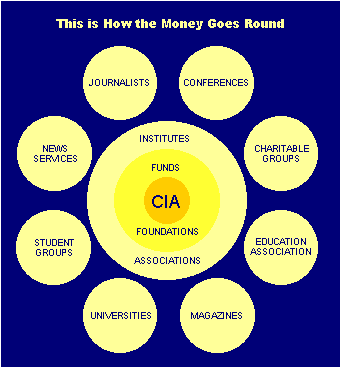
Consider the U.S. Central Information Agency's disinformation
program begun late in the 1940s and early 1950s.
This program eventually involved most of the major private
institutions in American life (John Harwood, "O What a Tangled Web the
CIA Wove," Washington Post, February 26, 1967). "It was not enough for
the United States to arm its allies, to strengthen government
institutions, or to finance the industrial establishment through
economic and military programs," wrote Mr. Harwood. "Intellectuals,
students, educators, trade unionists, journalists and professional men
had to be recruited directly through their private organizations."
"The idea was," writes former U.S. Department of State official
William Blum, and author of Rogue State: A Guide to the World's Only
Superpower, "the NED would do somewhat overtly what the CIA had been
doing covertly for decades, and thus, hopefully, eliminate the stigma
associated with CIA covert activities."
Allen
Weinstein, who helped draft the legislation establishing
NED, is reported to have said: "A lot of what we do today was done
covertly 25 years ago by the CIA."
The major recipients of NED funds include the International
Republican Institute; the National Democratic Institute for
International Affairs; American Center for International Labor
Solidarity (an AFL-CIO affiliate); Center for International Private
Enterprise (a Chamber of Commerce affiliate).
These institutions disburse funds to other organizations which
intervene in the "internal affairs of foreign countries by supplying
funds, technical know-how, training, educational materials, computers,
faxes, copiers, automobiles, and so on, to selected political groups,
civic organizations, labor unions, dissident movements, student
groups, book publishers, newspapers, other media, etc.," writes Mr.
Blum.
"In the decade since the end of the Cold War," writes Michael
Dobbs of the Washington Post, "democracy assistance has become an
American growth industry." The U.S. Agency for International
Development spent $649 million on democracy programs in 2000, a
substantial increase from $165 million in 1991. It is reasonable to
assume that advisers funded by the NED, also participate in these
democracy assistance programs.
This January 2001, following his innauguration as president, Mr. George Bush
announced the creation of a new White House Office of Faith-Based and Community
Initiatives. Aside from the constitutional issues relating to the separation of
church and state, some issues merit discussion: How will organizations be
selected to receive federal funds? Is this just another way for those in power
to divide and rule?
The likely result is that leaders of organizations receiving government
funds, will tend to place a higher priority on assuring the continuity of their
government funding, than on the interests of their members.
["Such a program would aim to undermine mosques and religious schools in the
Middle East and Southwest Asia that have become breeding grounds for Islamic
militancy. It might funnel money to help establish alternative schools or pay
foreign journalists to write articles favorable to American policies."--Eric
Schmitt, "White House
Plays Down Propaganda by Military," New York Times, December 17, 2002]
[K. S. Latourette at Yale helped kick-start East Asian studies (his
1929 book is History of the Christian Missions in China); H. E. Bolton at
Berkeley pioneered Latin American Studies (his 1936 book is The Rim of
Christendom: A biography of Eusebio Francisco Kino, Pacific Coast Pioneer); A.
C. Coolidge at Harvard worked out the contours of Slavic Studies (his big book
of 1908 is entitled The United States as a World Power). In its infancy, the
Church and Washington held sway over Area Studies. Our evangelical imperials of
today want to return to this period.--Vijay Prasad, "Confronting the
Evangelical Imperialists," CounterPunch, November 13, 2003]
Michael E. Salla, "The
Black Budget Report: An Investigation into the CIA's 'Black Budget' and the Second
Manhattan Project," American University, November 23, 2003
[. . . he accused the Summer Institute of Linguistics (SIL), an evangelical missionary
group from the United States, of sinister collusion with the oil companies.--John
Perkins, "Confessions of
an Economic Hit Man: How the U.S. Uses Globalization to Cheat Poor Countries Out of
Trillions," Berrett-Koehler Publishers (November 9, 2004), p. 142]
[Why would two such disparate areas as Muslim Algeria and Hindu Rajasthan, India, pass
laws that infringe upon both freedom of speech and freedom of religion? The sad truth is
that there has been a long tradition of Christian missionary efforts being used for
nefarious purposes over the centuries.--Jerald F. Dirks, "On Proselytizing," American Muslim, May 4, 2006]
[Other capitalist democracies now have government foundations similar to NED, and they
work collaboratively, e.g., the Canadian Rights and Democracy and the British
Westminster Foundation for Democracy. Additional US agencies have joined NED and the
CIA in this work, notably, the Agency for International Development (USAID) and United
States Information Agency (USIA), which support and create foreign NGOs and media.
. . . these public-private philanthropies have worked together to fund and direct
overthrow movements. . . . The grantees' activities included destabilization, the
creation of mobs preventing elected governments from ruling, chaos, and violence. Among
those funded were the Civic Forum in Czechoslovakia, Solidarity in Poland, Union of
Democratic Forces in Bulgaria, Otpor in Serbia, and, more recently, similar groups in
the succession states of the USSR. Sometimes mobs (especially of young people) have
been moved around from one country to another to give the impression of vast popular
opposition. The NED, Rockefeller and Ford Foundations, and the Soros philanthropies
have been particularly active in these operations. Human Rights Watch (formerly
Helsinki Watch) has nurtured opposition groups.--Joan Roelofs, "The NED, NGOs and the
Imperial Uses of Philanthropy: Why They Hate Our Kind Hearts, Too,"
counterpunch.org, May 13, 2006]
[Private companies now perform key intelligence-agency functions, to the tune, I'm told,
of more than $42 billion a year. Intelligence professionals tell me that more than 50
percent of the National Clandestine Service (NCS) - the heart, brains and soul of the
CIA - has been outsourced to private firms such as Abraxas, Booz Allen Hamilton,
Lockheed Martin and Raytheon.
. . . more than half the workforce in two key CIA stations in the fight against
terrorism - Baghdad and Islamabad, Pakistan - is made up of industrial contractors--R.J.
Hillhouse, "Who Runs the CIA? Outsiders for Hire," Washington Post, July 8, 2007]
DOCUMENTARY: John Pilger, "The War On
Democracy," johnpilger.com, 2007 -- The National Endowment for Democracy
funded the 2002 coupe against the Hugo Chavez government in Venezuela
Jeff Sharlet, "The
Family: The Secret Fundamentalism at the Heart of American Power,"
Harper Perennial (June 2, 2009)
[ . . . the US Congress voted $120 million for anti-regime media broadcasts into
Iran, and $60-75 million funding opposition parties, violent underground
Marxists like the Mujahidin-i-Khalq, and restive ethnic groups like Azeris,
Kurds, and Arabs under the so-called 'Iran Democracy Program.' . . .
Pakistani intelligence sources put CIA's recent spending on 'black operations'
to subvert Iran's government at $400 million.--Eric Margolis, "Seeing Through All the Propaganda About
Iran," ericmargolis.com, June 22, 2009]
[After years of trying to hide it, Robert Menard, Paris-based Secretary-General
of Reporters Sans Frontieres or RWB, confessed that the RWB budget was primarily
funded by "US organizations strictly linked to US foreign policy." Those US
organizations behind RWB include the Open Society Foundation of billionaire
speculator, George Soros, the US Agency for International Development (USAID)
and the US Congress' National Endowment for Democracy (NED). Also included is
the Center for Free Cuba, whose trustee, Otto Reich, was forced to resign from
the George W. Bush Administration after exposure of his role in a CIA-backed
coup attempt against Venezuela's democratically elected President Hugo Chavez.
As one researcher found after months of trying to get a reply from NED about
their funding of Reporters Without Borders, which included a flat denial from
RSF executive director Lucie Morillon, the NED revealed that Reporters Without
Borders received grants over at least three years from the International
Republican Institute. The IRI is one of four subsidiaries of NED.--F. William
Engdahl, "Reporters
Without Borders seems to have a geopolitical agenda," voltairenet.org,
May 5, 2010]
[And in 2005, the US Congress authorized $3 million to fund "the advancement of
democracy and human rights" in Iran, a move the Iranian UN ambassador called a
"clear violation of the Algiers
accords". . . .
In 2008, president George W Bush signed a "non-lethal presidential finding"
that, according to ABC News, initiated a CIA plan involving "a coordinated
campaign of propaganda, disinformation and manipulation of Iran's currency and
international financial transactions".--Rob Grace, "Covert ops
sabotage US-Iran ties," atimes.com, October 24, 2010]
Tony Cartalucci, "Naming Names: Your Real Government," Land Destroyer
Report, March 21, 2011
[CSID appears to be funded entirely by the U.S. government -- when asked,
Masmoudi did not deny it. One of its officers or employees, Radwan Ziadeh, lists
his address at the National Endowment for Democracy (NED) in Washington,
DC.--Enver Masud, "Revealed: America's Hidden
Hand Behind The UN Resolution For A No-fly Zone Over Libya," The Wisdom Fund,
March 19, 2011]
[The New York Times in its article, "U.S. Groups Helped Nurture Arab Uprisings," clearly stated as
much when it reported, "a number of the groups and individuals directly involved
in the revolts and reforms sweeping the region, including the April 6 Youth
Movement in Egypt, the Bahrain Center for Human Rights and grass-roots activists
like Entsar Qadhi, a youth leader in Yemen, received training and financing from
groups like the International Republican Institute, the National Democratic
Institute and Freedom House, a nonprofit human rights organization based in
Washington."--Tony Cartalucci, "BOMBSHELL: US Caught Meddling in Russian Elections! Putin
compares US funded NGOs to Judas the betrayer," Land Destroyer Report,
December 4, 2011]
[The IRI is an international arm of the U.S. Republican Party, . . . in 2004,
the IRI played a major role in overthrowing the democratically elected
government of Haiti. In 2002, the head of the IRI publicly celebrated the
short-lived military coup that overthrew the democratically elected government
of Venezuela. The IRI was also working with organizations and individuals that
were involved in the coup. In 2005, the IRI was involved in an effort to
promote changes in Brazil's electoral laws that would weaken the governing
Workers' Party of then President Lula da Silva.--Mark Weisbrot, "Egypt's crackdown on Republican and
Democratic organisations is hardly surprising: they're widely seen as stooges of
US empire," Guardian, January 31, 2012]
[It's a tale about some of the most quoted members of the Syrian opposition
and their connection to the Anglo-American opposition creation
business.--Charlie Skelton, "The Syrian Opposition: Who's Doing The Talking?,"
Guardian, July 12, 2012]
[CAII doesn't just restrict itself to Orwellian revisionism. It also plays a
part in covert operations.--Mark Graham, "USAID in
Afghanistan: Plunderers and Prey," counterpunch.org, December 5, 2012]
[While U.S.-funded democracy promotion is portrayed as benign, the National Endowment
for Democracy, the International Republican Institute, DNI, and Freedom House have been
linked to revolutions that brought down regimes in Serbia, Ukraine, Georgia, Uzbekistan,
and Kyrgyzstan, and nearly succeeded in Belarus.--Patrick J. Buchanan, "Outside
Agitators," antiwar.com, June 7, 2013]
[Washington's democracy assistance programme for the Middle East is filtered through a
pyramid of agencies within the State Department. Hundreds of millions of taxpayer
dollars is channeled through the Bureau for Democracy, Human Rights and Labor (DRL), The
Middle East Partnership Initiative (MEPI), USAID, as well as the Washington-based,
quasi-governmental organisation the National Endowment for Democracy (NED).
In turn, those groups re-route money to other organisations such as the International
Republican Institute, the National Democratic Institute (NDI), and Freedom House--Emad Mekay, "US
bankrolled anti-Morsi activists," aljazeera.com, July 10, 2013]
[Over at least two years, the U.S. Agency for International Development - best known for
overseeing billions of dollars in U.S. humanitarian aid - sent nearly a dozen neophytes
from Venezuela, Costa Rica and Peru to gin up opposition in Cuba.--Desmond Butler et al,
"US Sent Latin Youth Undercover in Anti-Cuba Ploy," ap.org, August 4, 2014]
[Cohen's directorate appeared to cross over from public relations and "corporate
responsibility" work into active corporate intervention in foreign affairs at a level
that is normally reserved for states. Jared Cohen could be wryly named Google's
"director of regime change."--Julian Assange,
"Google Is
Not What It Seems," newsweek.com, October 5, 2014]
[When Whitlam was re-elected for a second term, in 1974, the White House sent Marshall
Green to Canberra as ambassador. Green was an imperious, sinister figure who worked in
the shadows of America's "deep state". Known as the "coupmaster", he had played a
central role in the 1965 coup against President Sukarno in Indonesia - which cost up to
a million lives.--John Pilger, "How America and
Britain Crushed the Government of Their 'Ally' Australia," counterpunch.org, October
23, 2014]
[In 2014 USAID was caught red-handed in bizarre schemes to destabilize Cuba through
Twitter and by funding hip hop artists. . . .
"DAI acted as a conduit for USAID (through the Office of Transition Initiatives) and National
Endowment for Democracy (NED} funds to the Venezuelan opposition to president Hugo
Chavez."--Carmelo Ruiz-Marrero, "Who
Was Alan Gross Working For?," counterpunch.org, December 22, 2014]
[NED and Freedom House often work as a kind of tag-team with NED financing
"non-governmental organizations" inside targeted countries and Freedom House berating
those governments if they crack down on U.S.-funded NGOs.--Robert Parry, "CIA's
Hidden Hand in 'Democracy' Groups," consortiumnews.com, January 8, 2015]
[The White Helmets were founded in collaboration with USAID's Office of Transitional
Initiatives - the wing that has promoted regime change around the world - and have been
provided with $23 million in funding from the department. USAID supplies the White
Helmets through Chemonics, a for-profit contractor based in Washington DC that has
become notorious for wasteful aid imbroglios from Haiti to Afghanistan.--Max Blumenthal, "How the White Helmets Became International Heroes
While Pushing U.S. Military Intervention and Regime Change in Syria," alternet.org,
October 2, 2016]