From the Gulf War of 1991, to
September 11, 2001, and the invasion, and occupation of Afghanistan and
Iraq, the U.S. government and major news media have concealed the truth.
On March 16, 2006, George W. Bush presented the U.S. National Security
Strategy (NSS) the twin pillars of which are:
- promoting freedom, justice, and human dignity;
- confronting the
challenges of our time by leading a growing community of democracies.
Defeating global terrorism is a key component of this strategy intended to
achieve the NSS goals. Indeed the war on terrorism, launched shortly after
the attacks of September 11, 2001, was intended to do just that.
Arguably the U.S. occupation of Afghanistan and Iraq have created more "terrorists", and the facts reveal
that freedom, justice, human dignity, and democracy are not the real goals
of the NSS.
Rumsfeld fired Gen. Garner for trying to build a democratic Iraq.
In September 2003 I asked:
"Israel does not have a written constitution. The British do not have a
written constitution. The U.S. constitution provided few benefits for the
majority of Americans for over 150 years. So why must the Iraqis wait for a
new constitution before the U.S. occupation force transfers power to them?"
Author and investigative journalist Greg Palast confirms the answer given by
many in the alternative news media. In his April 14, 2006 column, Palast relates his
conversation with General Jay Garner - the United States' first
post-invasion "viceroy" in Iraq:
"Garner arrived in Kuwait City in March 2003 working under the mistaken
notion that when George Bush called for democracy in Iraq, the President
meant the Iraqis could choose their own government. Misunderstanding the
President's true mission, General Garner called for Iraqis to hold
elections within 90 days and for the U.S. to quickly pull troops out of
the cities to a desert base. 'It's their country,' the General told
Palast of the Iraqis. 'And their oil'."
Gen. Garner's tenure as "viceroy" was short-lived. "On April 21, 2003," writes
Palast, "the very night General Garner arrived in Baghdad, he got a call
from Washington. It was Rumsfeld on the line. He told Garner, in so many
words, 'Don't unpack, Jack, you're fired'."
Garner was replaced by Paul Bremer, the Managing Director of Kissinger
Associates, who postponed elections for a year. Then "he issued 100 orders,"
writes Palast "selling off Iraq's
economy to U.S. and foreign operators, just as Rumsfeld's neo-con clique had desired."
"The 9/11 Commission Report" offers no explanation for the collapse of the
47-story Building 7 of the World Trade Center.
The Project for the New American Century (PNAC), in a report titled "Rebuilding
America's Defenses," wrote: "the process of transformation, even if it brings
revolutionary change, is likely to be a long one, absent some catastrophic
and catalyzing event - like a new Pearl Harbor."
For most Americans, reducing defense
spending may be the way to a better life. The September 11, 2001 attack
on the Pentagon and the World Trade Center was for PNAC, and its neo-con
allies, the "new Pearl Harbor."
"The 9/11 Commission Report" - the official U.S. explanation of September 11 -
is full of inconsistencies. Consider just one.
The twin towers of the World Trade Center were obliterated. The 47-story
Building 7 of the World Trade Center (WTC 7) collapsed in about seven
seconds.
"The 9/11 Commission
Report" tells us that the Mayor's Office of Emergency Management was
located on the 23rd floor of WTC 7, and at 8:48 AM the Emergency Operations
Center was activated, but it does not mention the collapse of WTC 7. Major
news media have largely ignored this glaring omission.
Videos of the collapse of the 47-story WTC 7, while readily available on alternative news sites, have
generally not been shown to the public by major news media after September
11. The collapse of the nine-story Murrah
Federal Building in downtown Oklahoma City on April 19, 1995 was repeatedly
shown on television, and initially blamed on Muslim terrorists.
Scholars such as theologian Dr. David
Ray Griffin, and MIT engineer Jeff
King question the official version of September 11. Dr. Steven E.
Jones, a physics professor at Brigham Young University, writes:
"Concluding remarks in the FEMA report on the WTC 7 collapse lend support to
my arguments: The specifics of the fires in WTC 7 and how they caused the
building to collapse ["official theory"] remain unknown at this time."
Prof. Jones attempted to make his point on MSNBC's "The Situation" with
Tucker Carlson last November.
Actor Charlie Sheen, during his appearance with radio talk show host Alex
Jones on CNN's "Showbiz Tonight" last month, said: "It seems to me like 19
amateurs with box cutters taking over four commercial airliners and hitting
75% of their targets, that feels like a conspiracy theory."
CNN asked its viewers: "Do you agree with Charlie Sheen that the U.S.
government covered up the real events of the 9/11 attacks?" The results
after 15,079 votes had been cast: 83% voted "Yes"; 17% voted "No".
Among those questioning the "The 9/11 Commission Report" are Rep. Cynthia
McKinney, former presidential advisor and CIA analyst Ray McGovern,
economist Morgan
Reynolds, and former Assistant Secretary of the U.S. Treasury Paul Craig Roberts - the father of Reaganomics.
The September 11 attacks were used to rally Americans behind the U.S. attack on Afghanistan, and
the 2003 invasion and occupation of Iraq.
Saddam Hussein was "assured by the United States that it would have no
objection to his claiming his prize - Kuwait."
Dr. George Friedman whose firm Stratfor has been dubbed by Barron's as
"The Shadow CIA", and who has provided analysis to Fortune 500 companies,
news outlets, and the U.S. government writes in his book "America's Secret War":
"The Carter administration wanted to motivate Saddam to fight, but he
had little to gain simply by fighting Iran. What Saddam wanted was to
become the dominant power in the Persian Gulf. Absorbing Kuwait, which
had historically been a part of Iraq under the Ottoman Empire until the
British carved it our for their own interests, was a key goal, but so
was dominating the region politically. He knew that if he defeated
Iran, Iraq would be the dominant power in the region. He was also
quietly assured by the United States that it would have no objection to
his claiming his prize - Kuwait - once he defeated Iran. The assurances
were very quiet and very deniable. . . .
"In his famous meeting with U.S. Ambassador April Glaspie on July 25,
1990, just before the invasion, Saddam calmly
explained his intention to invade Kuwait, and Glaspie, not informed by
the State Department that the policy had changed, proceeded to give
Saddam the reassurance of American support that had been the U.S.
policy transmitted by ambassadors and back channels for a decade. . . .
"What Glaspie didn't know. and what Glaspie hadn't been told, was that
the United States had never expected Iraq to win and certainly was not
prepared to let Saddam collect his war prize."
Iraq's subsequent invasion of Kuwait was used by President George H. W. Bush
to justify the 1991 war with Iraq, and the crippling sanctions that followed
the war.
The sanctions were maintained throughout the Clinton administration, and into
the George W. Bush administration.
On January 6, 1992, John R. MacArthur, publisher of Harper's Magazine and
author of "Second
Front: Censorship and Propaganda in the Gulf War," revealed in a New
York Times Op-Ed that
"Nayirah," the alleged refugee, was the daughter of Saud al-Sabah, Kuwait's
ambassador to the United States, and that Hill and Knowlton, a large public
relations firm, had helped prepare her testimony, which she had rehearsed
before video cameras in the firm's Washington office.
"The chairmen of the Congressional group, Tom Lantos, a
California Democrat, and John Edward Porter, an Illinois Republican,
explained that Nayirah's identity would be kept secret to protect her family
from reprisals in occupied Kuwait" wrote MacArthur.
To build bases in Saudi Arabia, from which to launch the 1991 war on Iraq,
the U.S. lied to the Saudis.
On September 6, 2002, Scott Peterson of the Christian Science Monitor, wrote:
"When George H. W. Bush ordered American forces to the Persian Gulf - to
reverse Iraq's August 1990 invasion of Kuwait - part of the
administration case was that an Iraqi juggernaut was also threatening
to roll into Saudi Arabia.
"Citing top-secret satellite images, Pentagon officials estimated in
mid-September that up to 250,000 Iraqi troops and 1,500 tanks stood on
the border, threatening the key US oil supplier.
"But when the St. Petersburg Times [Jean Heller, January 6, 1991] in
Florida acquired two commercial Soviet satellite images of the same
area, taken at the same time, no Iraqi troops were visible near the
Saudi border - just empty desert."
The "top-secret satellite images" were used to persuade the Saudis to allow
U.S. troops into Saudi Arabia - home of the holiest of Muslim shrines, the
Kaaba at Mecca. The U.S. bases in Saudi Arabia turned Osama Bin Laden, who
had sided with the U.S. in expelling the Soviet Union from Afghanistan,
against the U.S.
[Referring to discussions he had had with U.S. leaders in October 1989 as
well as to debate at the May 30, 1990 Baghdad Summit, Aziz summed up the
situation as it appeared to Iraq at the time: "So the picture in 1990 was
one of Israeli threats to Iraq with the prospect of a war between Israel and
Iraq, and an Israeli threat against Jordan, and an Israeli threat to the
Palestinian people . . . ." On top of this came the economic warfare launched by
Kuwait, which had flooded the oil markets, triggering a drop in the oil
price from $21 a barrel to $11 a barrel. Iraq was "on the verge of economic
collapse," Aziz said. Despite an agreement struck at a meeting of oil
ministers to return to quota levels, "the Kuwaiti oil minister issued a
statement after the meeting which said Kuwait would go back to the old
position in two months’ time." Aziz concluded: "What he was saying
constituted war against Iraq." Thus the move against Kuwait was in
self-defense.
Significantly, it was at this point that Tariq Aziz made an interesting
offer to Baker, to cooperate to reach a "just, comprehensive and lasting
peace for the whole region," and added that, unless the Palestinian issue
were resolved, "our security in Iraq will continue to be threatened." Aziz
concluded his case by rejecting the double standard used by the US. "There
are other UN resolutions to be implemented," he said, obviously referring to
those condemning Israel's occupation of Palestinian lands. "But there are no
forces sent to implement them."--Muriel Mirak-Weissbach, "Why Tariq Aziz Should Be
Released," intifada-palestine.com, September 16, 2010]
ON THE BORDER QUESTION, SADDAM REFERRED TO THE 1961 AGREEMENT AND A "LINE OF
PATROL" IT HAD ESTABLISHED. THE KUWAITIS, HE SAID, HAD TOLD MUBARAK IRAQ WAS
20 KILOMETERS "IN FRONT" OF THIS LINE. THE AMBASSADOR SAID THAT SHE HAD
SERVED IN KUWAIT 20 YEARS BEFORE; THEN, AS NOW, WE TOOK NO POSITION ON THESE
ARAB AFFAIRS."--SADDAM'S
MESSAGE OF FRIENDSHIP TO PRESIDENT BUSH," AMEMBASSY BAGHDAD, July
25, 1990 (revealed Jan 2011 by Wikileaks)
[When one reads the communications between Washington and Iraq, it was not difficult to
believe that a green light had been given to Saddam Hussein to march into Kuwait without
US interference. Without this invasion, getting the American people to support a war
with Iraq would have been very difficult. . . .
On August 1, 1990, one week after this exchange between ambassador Glaspie and Saddam
Hussein, the invasion of Kuwait by Iraq occurred. Immediately following this attack our
State Department made it clear that this invasion would not stand and President Bush
would lead a coalition in removing Iraqi forces from Kuwait.--Ron Paul, "A Green Light for the American Empire,"
ronpaulinstitute.org, March 14, 2015]
[the Iraq War didn't begin on March 20, 2003 as everybody thought, it began ten months
earlier on May 20, 2002 when the allies started the secret air war. It was definitely
illegal because it started six months before the UN Security Council passed Resolution
1441 which Tony Blair's government later used to claim the war was legal.--Michael
Smith, "The
Secret US-UK Airwar Against Iraq," antiwar.com, July 26, 2016]

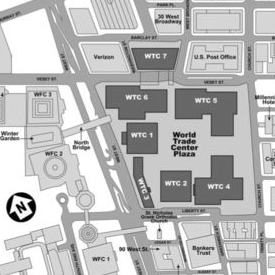 The twin towers of the World Trade Center were obliterated. The 47-story
Building 7 of the World Trade Center (WTC 7) collapsed in about seven
seconds.
The twin towers of the World Trade Center were obliterated. The 47-story
Building 7 of the World Trade Center (WTC 7) collapsed in about seven
seconds.